


JANUARY 9, 2026
By ESTHER J | FRONTIER
This article was written with support from the Pulitzer Center.
On October 17 last year, the military launched an offensive in several villages south of the controversial Letpadaung copper mine in Sagaing Region’s Salingyi Township. The offensive was aimed at cracking down on resistance groups.
A humanitarian aid worker told Frontier, on condition of anonymity, that thousands of residents from 15 villages were forced to flee. However, a handful of men remained in their villages to take care of property – a decision some came to regret.
Two days after launching the attack, regime soldiers detained three men in Se Te, a village two kilometres south of the fence protecting Letpadaung. Se Te was set up for farmers evicted from their land in successive waves from 2011 to 2017 to make way for the mining site’s expansion.
The soldiers took the men to a monastery and the next morning used them as human shields in an attack on Hpaung Ka Tar village, where local People’s Defence Forces under the command of the National Unity Government were stationed. The resistance rebuffed the attack, forcing the regime to withdraw later that morning.
Two of the kidnapped men, Ko Aung Khaing and U Win Tint, were badly injured, while another, Ko Zaw Zaw, managed to escape. The PDF took the two injured men to the hospital, but Aung Khaing died on the way and Win Tint succumbed to his wounds in the medical facility.
“He was beaten and his arms looked like they were slashed by a knife. They were bleeding heavily and his right arm was gouged out,” Ko Ye Ko, the brother of Aung Khaing, told Frontier. “His legs were broken and twisted. I was very sad. We didn’t find severe injuries on his face, but the area around his ears and temple was swollen and bloody.”
Before Aung Khaing’s death, his mother, who is 73 years old, was in good health, except for occasional fits of dizziness. After his death, her dizziness worsened, and she experienced blurred vision. She was diagnosed with hypertension and now she has to visit a clinic every day for treatment.
“My mother cried out loud, praying that her son would not have to experience anything like this in his next life,” Ye Ko said. “My aunts were also crying. We all suffered from this brutal killing.”
He added, “When this happened to my brother, all we could do was endure it because we were unable to fight back or respond. Now, every time we think about how cruel it was, we end up in tears. It was not a normal death. He was brutally tortured.”
The Done Taw massacre
This violent episode is far from unique in the area. On the morning of December 7, 2021, 30-year-old Ma Thi Thi was at her home in Done Taw village when she heard an explosion nearby, followed by a loud commotion.
Her husband went to investigate. Thi Thi heard shouting and machine gun fire, and she realised junta troops were sweeping through the village, also located in Salingyi.
Once it quietened down, Thi Thi left the house to look for her husband. To her horror, she discovered a pile of burnt corpses, including her husband, five children and several others.
Some victims had their hands tied, indicating they had been burnt alive. Thi Thi could only identify her husband’s body by a piece of his clothing.
“There were bloodstains and brain matter,” Thi Thi told Frontier, using a pseudonym for security purposes. “I saw a piece of my husband’s shirtsleeve. I started grabbing and pulling whatever I could to pull the bodies out of the pile, but the heat was still too intense from the smouldering fire.”
Thi Thi’s husband had been a member of a group organised to defend the village against junta troops. At best they were armed with homemade weapons, but Thi Thi said the soldiers had arrived and rampaged through the village so quickly that her husband and the others had been unarmed when they were killed.
The killings came to be known as the Done Taw massacre, drawing widespread outrage on social media and condemnation from international human rights organisations.
But few media outlets linked the incident to the nearby Letpadaung, Sabetaung and Kyesintaung copper mines, which are run by China-based Wanbao Mining Ltd in collaboration with the military.
Junta troops provide security for convoys entering and exiting the mines twice a month, ensuring safe passage. The convoys, from Monywa town, deliver raw materials needed to mine copper, as well as food for the workers.
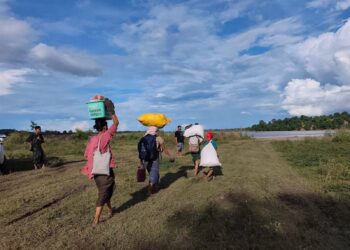
During the deliveries, thousands of villagers near the project sites are forced to flee, sometimes for two or three days, and other times up to four months.
“We always have our bags packed,” Thi Thi said. “When the convoys come, we’re ready. We just grab our motorbikes and escape.” They only take essentials – rice, oil, food and drinking water, as well as some clothes, a mosquito net and a blanket.
Foreign control
Foreign companies have been extracting copper from Salingyi Township since the previous military dictatorship under General Than Shwe. In 1994, Canadian company Ivanhoe partnered with the Ministry of Mines at Sabetaung but withdrew in 2010 due to Western sanctions.
Since then, the mines have been managed by the Chinese Wanbao Mining Ltd and its subsidiaries, Myanmar Wanbao Mining Copper Ltd and Myanmar Yang Tse Copper Ltd, in collaboration with the military-owned Union of Myanma Economic Holdings Ltd.
Land seizures around the mines by Wanbao – a subsidiary of state-owned defence firm China North Industries Group Corporation Ltd, or Norinco Group – sparked protests in 2012 that were violently suppressed and brought National League for Democracy leader Aung San Suu Kyi to the area to hear the farmers’ grievances. Those disputes remain unresolved, and human rights violations around the mines have increased, especially since the 2021 military coup.
Before the coup, the mining sites were protected by civilian security personnel hired by the company. But after the military takeover, junta troops were stationed around and inside the mining area.
“The military council has stationed a large force to protect the mines and show China they’re operational,” said Ko Paing, leader of a local People’s Defence Team under the NUG.
“Before, security was provided by the company, and the guards had no guns. Now, the junta’s North Western Command provides armed soldiers for security. The Yang Tse site at Kyesintaung has about 300, and Wanbao at Letpadaung has at least the same.”
Meanwhile, local anti-junta defence forces began targeting the projects because they provide financial support to the regime. They have engaged in sabotage, planted landmines, and destroyed power lines and water pipelines. However, in recent years the resistance has abstained from publicising these attacks to avoid drawing the ire of Beijing.
According to several locals who spoke with Frontier – including a village administrator and the wife of a Wanbao employee – on August 16 last year, the Letpadaung mine was attacked by resistance groups. One mine worker, 43-year-old Ko Kyaw Naing, died in the attack. The military responded by using a paraglider to drop bombs on a nearby village, killing a 60-year-old woman.
On September 27 and October 24, the Letpadaung mine was attacked again by resistance groups, but details about the damage and casualties have not been disclosed. Junta troops have responded with heavy, indiscriminate shelling and sweeps of villages – a tactical measure to clear resistance ahead of the convoys.
“They use heavy artillery,” Ko Paing said. “Even if we don’t attack them, civilians are hit.”
The Done Taw massacre occurred in the wake of attacks by resistance forces using homemade explosives against junta troops escorting a convoy on two consecutive days.
‘They don’t care about people’
After the coup, thousands of staff at the copper mines quit their jobs to join the Civil Disobedience Movement in protest against the military’s seizure of power. The exodus brought copper production to a stop.
By June 2024, however, mine workers began returning to their jobs due to economic hardship.
“No income means no livelihood,” said Ma Khine, a former Yang Tse employee working at the Kyesintaung mine, who used a pseudonym for protection. “Initially, everyone joined the CDM, including workers from Letpadaung and Kyesintaung. But family needs came before politics, and they returned to work. We understand our fellow employees’ struggles.”
The mines are now back to being fully operational. When Frontier recently visited the mining area, the sound of machinery could be heard at all hours, with blasting every day at 3pm.
However, the security situation has significantly deteriorated since mining resumed. Arrests and killings by junta troops have become regular occurrences. Troops often vandalise and loot villages along the convoy route, arresting people caught outside.
“They take whoever they find as hostages,” said teacher Daw Kyawt, who spoke to Frontier using a pseudonym. “If they find money, they take it. If they find a phone, they confiscate it.”
Local sources told Frontier that in June last year, about 40 villagers were reportedly arrested and used as human shields along the route the troops were securing.
Resistance forces control about 90 percent of the villages in Salingyi Township, while junta forces control Salingyi town and some nearby villages.
In April 2022, 16 local PDFs issued a demand that the copper mines be shut down. Two months later, they destroyed an electricity pylon that fed the mining sites.
In June 2023, revolutionary forces attacked the police station in Nyaung Pin Gyi village near the mines. In response, junta troops burned at least 500 houses before occupying the area surrounding the mines.
Shortly after, the Wanbao project expanded, forcing more than 30 households to move and fencing off the area. Although the company offered compensation, some households refused. Wanbao later announced on its Facebook page that it would employ one person from each household forced out of the area.
“They [the Chinese company] only look at their business,” said Daw Kyawt. “They don’t care about the people.”
In September 2023, the UN special rapporteur on the situation of human rights in Myanmar, Tom Andrews, sent a letter to Chen Defang, the head of the Wanbao company, raising concerns about human rights violations committed by troops in support of the Letpadaung mine.
“We are deeply concerned that Myanmar military officers involved in security actions connected to Wanbao’s operations may be actively committing human rights abuses,” the letter said.
It also accused Wanbao of “engaging in the intentional displacement of villagers from their homes and land in a context where rule of law has broken down, humanitarian relief is limited, and there is no due process or protection for villagers”.
Ko Paing said the company cares little for civilian casualties. “The company never issues statements of condolence. It doesn’t meet with the parents of the deceased – it takes no responsibility,” he said.
Wanbao responded to Andrews’ letter by releasing a statement saying the company is “committed to contributing to peace and development” and has been “continually offering vitally needed financial and moral support to our surrounding communities and workers in these difficult and turbulent times”.
The regime, China and the NUG
The copper mines are of great value to the junta. Myanmar’s exports of copper to China totalled $216 million in 2024, according to the United Nations COMTRADE database on international trade.
“The money from this copper is used by the military to produce weapons and bullets, and they are killing our people with it,” Ko Paing said.
Not only is the mined copper of particular value to the junta, but it is also used in the production of weapons. The project’s parent company Norinco Group is owned by the Chinese military.
According to activist group Justice For Myanmar, Norinco sells weapons to the regime.
In 2017, Norinco and the Myanmar military agreed to increase cooperation on defence material trade and related technology. The United Nations special rapporteur reported that China Wanbao Engineering Corporation, a subsidiary of Norinco, sold products valued at $5-10 million directly to Myanmar’s military.
Norinco is allegedly selling weapons to the regime through Myanmar crony companies, namely Star Sapphire Trading Company Limited and Mottama Holdings, according to Justice for Myanmar and Intelligence Online. Intelligence Online reported that U Yan Ho, the owner of Mottama Holdings, is acting as a broker for Norinco to import military equipment to the military through Singapore.
Letpadaung now produces 380 tonnes of copper daily, while Yang Tse Kyesintaung produces 185 tonnes, employing a total of at least 5,500 workers.
Following the PDF attack on the electrical power supply tower in June 2022, Wanbao issued a statement urging people to refrain from acts that endanger the public in the project area.
The statement said continued sabotage would only lead to Myanmar employees losing income, resulting in a socio-economic crisis. It added that power outages from the destroyed electrical tower could affect the surrounding areas.
“We condemn this incident in the strongest terms as it could have put our employees in harm’s way and caused untold damage to our surrounding community,” the statement said. “Attacks on the project puts our employees in great danger, which can escalate into a humanitarian crisis.”
Local sources reported that in 2022, U Yee Mon, the NUG’s minister of defence, had warned resistance forces against attacking Wanbao, leading to fewer incidents. And in January last year, the NUG issued a statement pledging to safeguard China’s economic investments and socio-economic ventures in Myanmar.
Nan Lwin Yadanar Aung, program head at the Institute for Strategy and Policy-Myanmar, China Studies Program, said the NUG tends to approach the Chinese government with a soft attitude because it understands China’s power and role in Myanmar.
“In approaching matters through an ‘adjusting to reality’ approach, the NUG can be seen engaging with China in a more lenient and softer tone to keep it on its side,” she said.
“When the Chinese government has a relationship with the NUG, it is not based on consistent political principles but rather on their interests – a transactional relationship. For example, when a Chinese project is attacked or when the safety of Chinese citizens is threatened, China may contact the NUG to request assistance.”
Ko Paing questioned how far Wanbao and Yang Tse would tolerate the killing of civilians by the junta. He called on the Chinese government to stop sharing profits with the military council for copper extraction and also called on the junta to stop assigning troops to secure the project, because of the abuse of civilians.
Between December 2021 and October last year, at least 73 civilians, including five children, were killed in artillery and paramotor bombings in Salingyi and adjacent Yinmabin townships.
A 13-year-old girl was killed by artillery near the Wanbao mine on April 12, 2023, and a nine-year-old child was shot in Done Taw village. While Frontier could not confirm the identity of the perpetrators, eyewitnesses in villages near the mines told Frontier they were committed by regime forces on patrol.
“We are the ones producing the copper that allows them to make these weapons and kill our people,” Ko Paing said. “If they continue oppressing the people, they won’t last long. I’m not speaking just for my group; other groups will attack too. If the people demand it, we will strike.”
It has been more than four years since Thi Thi’s husband was murdered in the Done Taw massacre. She remains steadfast in her opposition to the mines. “I want the project to stop,” she said.
Daw Kyawt shared this sentiment. “As long as the mines are running, we’ll have to flee,” she said. “I just hope the mines can be seized quickly by the resistance – only then will we be safe and free.”
Credit – Frontier Myanmar
Costs of copper: Residents near mines suffer under junta’s heavy hand